A research team develops a new surgical instrument. A clinician modifies an existing tool to solve a problem encountered during a procedure. A hospital innovation group creates a device that could make treatment easier, faster, or safer.
The prototype works. The clinical team is excited.
Then someone asks a deceptively simple question: How is the Medical Device Reprocessing Department going to clean and sterilize it?
For many hospital research and innovation teams, this is where an unexpected challenge begins.
The assumption may be that an experienced reprocessing department can determine an appropriate process based on similar instruments already used in the hospital. Increasingly, however, MDRDs are cautious about accepting new or modified devices without appropriate processing instructions and supporting evidence.
And for good reason.
The role of MDRD is not to develop and validate a medical device on behalf of the research team. Its responsibility is to consistently reprocess devices in a manner that protects patients and supports safe clinical care.
Hospital research exists to improve patient care. Researchers and clinicians may be trying to make a procedure less invasive, improve access, reduce complications, or create an option for patients who have few alternatives. Naturally, much of the team's attention goes toward one question:
Does the device work?
But for a reusable device, another question is just as important:
Can it be safely prepared for the next patient?
A successful clinical design does not automatically mean that the device can be effectively cleaned, disinfected, or sterilized. Device geometry matters. Materials matter. Hinges, joints, narrow channels, enclosed spaces, interfaces and other difficult-to-access areas can create challenges that may not be obvious when the device is designed primarily around clinical function.
This is not simply a regulatory technicality. Health Canada has identified inadequately reprocessed reusable medical devices as a potential source of exposure to pathogenic microorganisms and disease transmission.
An innovation intended to improve patient care should not inadvertently introduce a preventable infection-control risk. Safe reprocessing is part of safe device design.
Why MDRD Cannot Simply “Figure It Out”
Medical device reprocessing professionals have significant practical expertise. But that expertise should not be confused with responsibility for establishing whether an unvalidated process is appropriate for a new device.
Consider what sounds like a straightforward instruction: “It is stainless steel. Just clean it and put it through the steam sterilizer.”
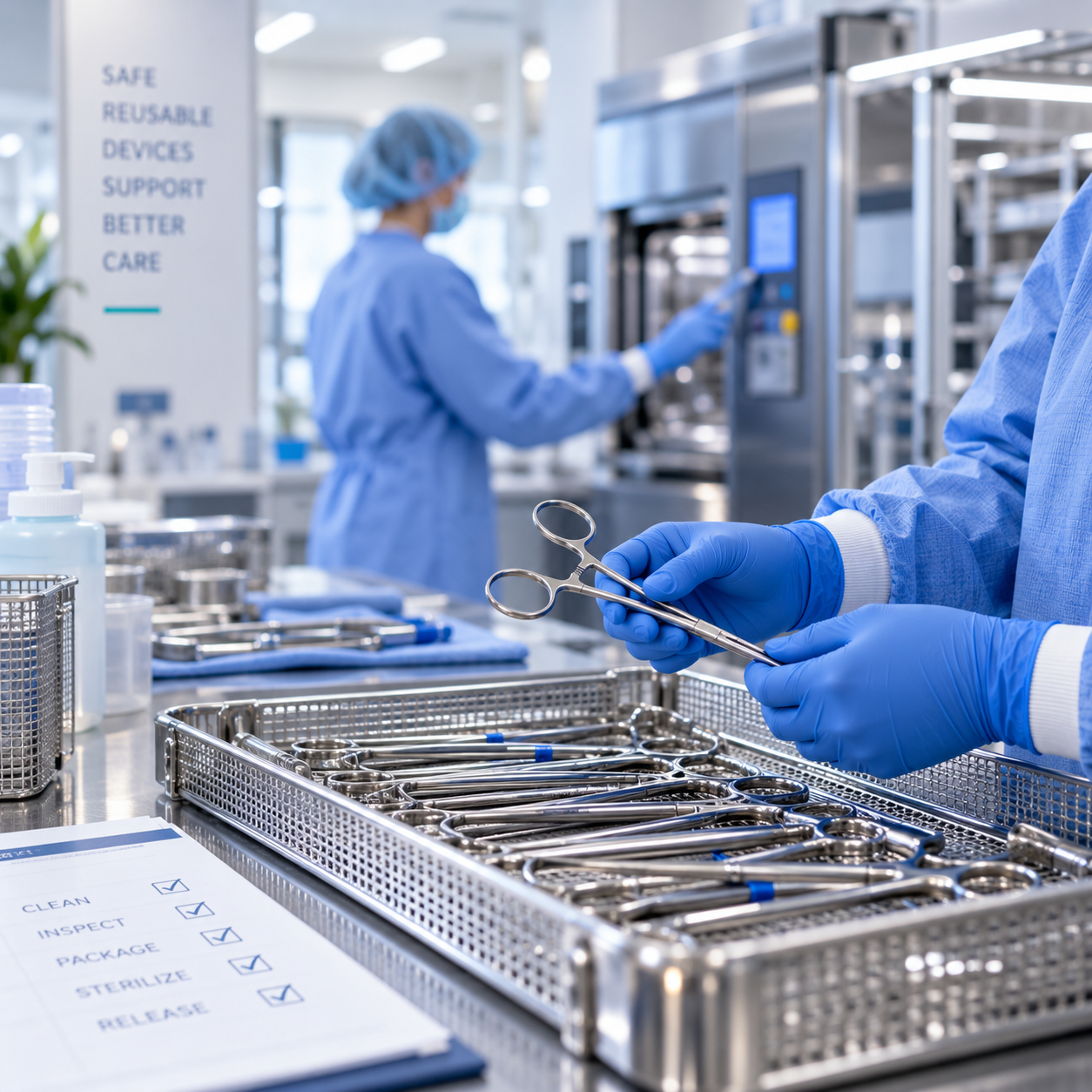
That still leaves important questions. Can every surface be reached during cleaning? Does the device need to be disassembled? Can soil become trapped inside a joint, channel or enclosed space? What cleaning chemistry is appropriate? Can steam reliably reach the most difficult locations? How should the device be packaged and dried?
ISO 17664-1 reflects this broader approach to reprocessing and addresses information related to cleaning, disinfection, drying, inspection, packaging, sterilization and other processing steps.
In other words: “Autoclave at 132°C” is not, by itself, a complete reprocessing procedure.
Canadian reprocessing practice is also supported by CSA Z314, which addresses safe and effective reprocessing of reusable medical devices. The practical question facing the hospital is therefore straightforward:
What evidence supports the procedure that MDRD is being asked to perform?
The Requirement Often Appears After the Budget Is Already Spent
This is one of the most common challenges we encounter with hospital research groups. Reprocessing validation was simply not included in the original project budget. Funding may have already been allocated to engineering, prototypes, materials, research personnel, clinical work or other development activities. Then, late in the project, the team approaches MDRD. MDRD asks for validated processing instructions. The research group contacts a laboratory and discovers that validation is not a few-hundred-dollar routine test that can easily be added at the last minute. This can be frustrating, particularly for academic and hospital research groups operating with limited funding.
At SteriLabs, we understand this reality. We work with hospital and research teams, offer discounted research pricing where appropriate, and look for practical ways to develop a proportionate study scope. But there is an important distinction between making validation more accessible and reducing a legitimate validation study to an unrealistic budget. A laboratory still needs to generate meaningful scientific evidence.
Why Validation Is More Than a Single Test
Depending on the device and its intended use, reprocessing validation can involve much more than placing an instrument into a washer or sterilizer and confirming that the cycle completed. The work may include understanding how the device will be used, where contamination may accumulate, which locations represent the greatest challenge, how the device is assembled, and what equipment is available at the hospital.
For cleaning, this can involve representative test soil, worst-case locations, simulated use, the proposed cleaning procedure and measurement of residual contamination. ANSI/AAMI ST98 provides a framework for the development and validation of cleaning processes for medical devices.
Sterilization validation raises different questions, including device configuration, packaging, sterilant penetration and whether the process can reliably reach the most difficult locations. The exact study should depend on the device and the risk.
Credible validation does not necessarily mean performing the largest possible study. It means generating appropriate evidence for the proposed use.
Validation Does Not Have to Mean Over-Validation
When hospital researchers hear the word validation, they may imagine a large commercial medical-device program costing tens of thousands of dollars. That does not always need to be the starting point. A research device intended for a controlled hospital study may present a different situation from a medical device being commercially distributed across many hospitals.
The appropriate question is not:
“What is the biggest validation package we can perform?”
It is:
“What evidence is reasonably necessary to demonstrate that the proposed reprocessing procedure is scientifically defensible for this device and its intended use?”
A thoughtful strategy can consider the stage of development, device design, clinical application, proposed processing procedure, hospital equipment, existing supporting information and overall risk. This is why involving a validation laboratory early can be valuable. It allows the research team to understand the likely scope before MDRD is waiting for an answer.
Reprocessing Should Be Part of the Research Budget From the Beginning
The biggest improvement may happen long before testing begins. When developing a reusable device, hospital research and innovation teams should consider three questions together:
Does it work?
Can it be used safely?
Can it be safely reprocessed for its next use?
Reprocessing should ideally be considered during device design, not after the final prototype reaches MDRD. When cleaning, disinfection or sterilization validation may be required, those activities should also be considered when preparing research grants, innovation funding applications, clinical study budgets and prototype-development plans. Even an early discussion with a validation laboratory can help establish an approximate scope and budget before funding is finalized. It can also influence the design itself. If a difficult-to-clean feature can be changed before the device is finalized, the solution may be much simpler than attempting to validate an unnecessarily challenging design later. If you are budgeting for the prototype, budget for the pathway to safely reuse it.
MDRD Is Not the Barrier to Innovation
When a research team is eager to begin using a device, a request from MDRD for additional documentation can feel like another hurdle. But MDRD is not the barrier.
The researcher understands the clinical problem. The engineer understands the design. The validation laboratory can generate evidence supporting the proposed processing procedure. And MDRD understands what can be reliably implemented within the hospital. All of those perspectives matter.
The objective is not to make innovation more difficult. It is to make successful innovations usable in a real hospital without asking reprocessing personnel to assume responsibility for a process that has not been adequately evaluated.
From Prototype to Patient
A reusable medical device is not ready for clinical implementation simply because it performs its intended function. It also needs to fit safely into the systems that surround patient care. The question “How are we going to clean and sterilize this?” should not first be asked when the finished device reaches the reprocessing department. It should be asked while the device is being designed, while the research protocol is being developed, and while the project budget is still being built.
At SteriLabs, we work with hospitals, research institutes and medical-device developers to assess new and modified reusable devices and develop practical, scientifically defensible approaches to cleaning, disinfection and sterilization validation. Engaging the validation team early can help identify reprocessing challenges, establish a realistic study scope and budget, and reduce the chance that reprocessing becomes an unexpected barrier between a promising innovation and its use in patient care.

About the Author
Dr. Anas Aljabo
Co-Founder & Executive Vice President, SteriLabs
Anas Aljabo is Co-Founder and Executive Vice President of SteriLabs, where he helps lead the company’s technical strategy, service development, and growth in medical device testing and validation. He works closely with hospitals, research institutions, and medical device manufacturers to translate complex reprocessing and sterilization challenges into practical, scientifically defensible solutions. His leadership focus is on expanding SteriLabs’ capabilities, strengthening industry partnerships, and supporting safer adoption of medical technologies.
Choosing a Medical Device Testing Laboratory: Why ISO/IEC 17025 Accreditation Matters, Blog Post by David Abiola
September 14, 2026
Using Biochemical Assays to Evaluate Medical Device Cleaning Processes. Blog post by Alice Shtutman
August 21, 2026
My SteriLabs Experience as an Interdisciplinary Biochemistry and Microbiology Intern. Blog post by Natasha Tal.
September 22, 2025
Microbiologist / Study Lead (Sterilization, Sterility Testing & QMS) — 24-Month Term
September 18, 2025

Media fill testing: Ensuring Aseptic Processing for Client Projects and Licence Applications. Blog Post by Natasha Tal
August 22, 2025
Designing safe and effective medical devices for home use, Blog Post by Andres Dumas
June 6, 2025


 +1 647-949-6661
 Prev
Prev